Commercial Modified Bitumen Roofing in Wheat Ridge, CO
Modified bitumen, known throughout the industry as mod-bit roofing, is a multi-ply asphalt-based commercial roofing system that combines the proven durability of traditional built-up roofing with the manufacturing consistency and installation efficiency of pre-manufactured roll goods. While single-ply membranes have taken substantial market share over the past two decades, modified bitumen remains the right answer for specific commercial applications: roofs with heavy foot traffic, buildings where multi-ply redundancy genuinely matters, and properties where the system’s proven 50+ year track record outweighs cool-roof reflectivity considerations. For the right Wheat Ridge, CO commercial buildings, mod-bit is still the strongest available choice.
Baseline Roofing and Solar installs commercial modified bitumen roofing systems across Wheat Ridge, CO and surrounding Colorado communities. We work with both SBS-modified (rubber-modified) and APP-modified (plastic-modified) systems. And we install using all four primary application methods, torch-applied, hot-mopped, cold-applied, and self-adhered. Because we’re certified across competing systems too (TPO, EPDM, PVC, BUR, spray foam). We’ll tell you straight whether modified bitumen is the right fit for your specific roof or whether a different system would actually serve you better.
On this page. We’ll explain what modified bitumen actually is, the difference between SBS and APP modifier chemistries, the four application methods and their trade-offs, why mod-bit still has a strong place in 2026 commercial roofing, the honest limitations to understand, and how mod-bit performs in Colorado’s specific climate.
What Modified Bitumen Roofing Actually Is
Modified bitumen is a multi-ply asphalt-based roofing membrane manufactured in rolls and installed in two or more layers (plies) over the substrate. Each ply is composed of asphalt that has been modified with polymer additives, either SBS (Styrene-Butadiene-Styrene, a thermoplastic rubber) or APP (Atactic Polypropylene, a thermoplastic), to enhance specific performance characteristics that unmodified asphalt lacks. The polymer modifiers give the membrane improved flexibility, better cold-weather performance, stronger UV resistance, and longer service life than the asphalt that built-up roofing relied on through most of the 20th century.
A typical commercial modified bitumen system consists of a base sheet (or base ply) installed first, then one or more cap sheets installed over it. The cap sheet is the final layer and typically carries a factory-applied granular surface that provides UV protection, fire resistance, and the finished appearance of the roof. Granules are most commonly white, gray, or earth tones, with white granular cap sheets offering meaningful cool-roof reflectivity that’s competitive with single-ply white membranes.
Modified bitumen has been installed on commercial buildings since the 1960s and has a proven track record across decades of real-world performance. It evolved from traditional built-up roofing as an improvement on the field-built BUR systems that were the commercial standard before, offering better quality control through factory manufacturing while preserving the multi-ply redundancy that made BUR successful.
SBS vs. APP: The Two Modifier Chemistries
Modified bitumen comes in two distinct chemistries, distinguished by which polymer is used to modify the asphalt. Each has specific properties and applications where it performs best.
SBS-Modified Bitumen (Rubber-Modified)
SBS modifiers add elastic, rubber-like properties to the asphalt, making the membrane flexible across a wide temperature range and giving it strong cold-weather performance. SBS is the more common of the two modifier chemistries in North American commercial roofing today, and it’s particularly well-suited to Wheat Ridge, CO’s cold winters and dramatic temperature swings. SBS-modified mod-bit can be installed using torch, hot-mop, cold-applied, or self-adhered methods, giving it the broadest application flexibility.
APP-Modified Bitumen (Plastic-Modified)
APP modifiers add thermoplastic, plastic-like properties to the asphalt, producing a membrane that’s particularly resistant to high temperatures and UV exposure. APP-modified mod-bit is most commonly installed using torch-down application (the heat melts the underside of the membrane to fuse it to the substrate). APP is more common in hotter climates than Wheat Ridge, CO and on roofs with significant solar exposure where the heat-resistance characteristics matter most.
Which one for Wheat Ridge, CO commercial buildings?
For most Wheat Ridge, CO commercial applications, SBS-modified bitumen is the better fit. Colorado’s cold winters and dramatic temperature swings reward SBS’s cold-weather flexibility. APP can be the right call on specific applications with heavy solar exposure or where the harder, more plastic-like surface offers advantages, but SBS is the default.
Modified Bitumen Application Methods
Modified bitumen offers four distinct application methods. Each has trade-offs around installation speed, weather sensitivity, fire safety, building access, and cost.
Torch-Applied (Torch-Down) Modified Bitumen
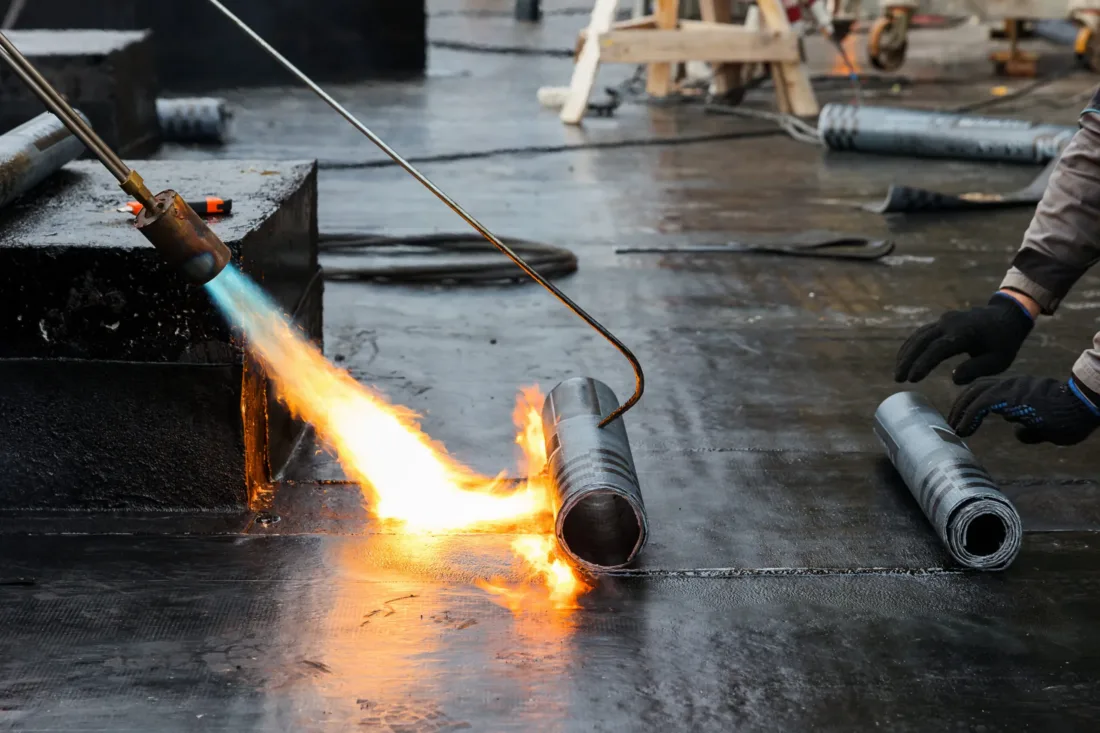
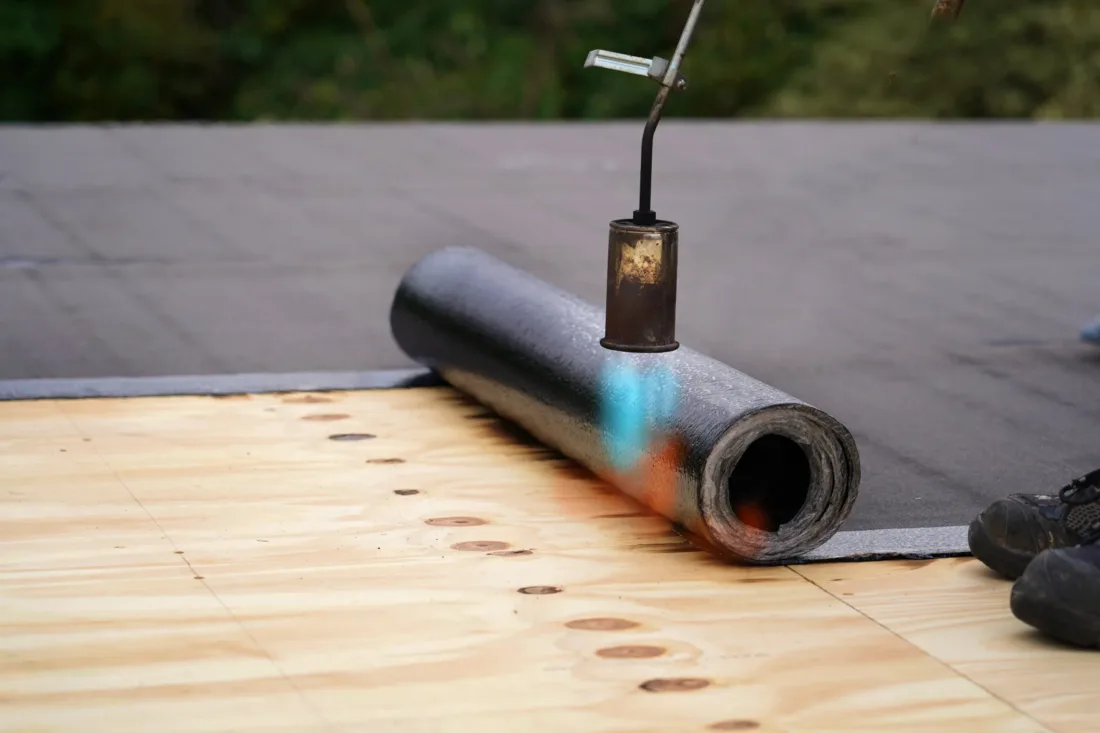
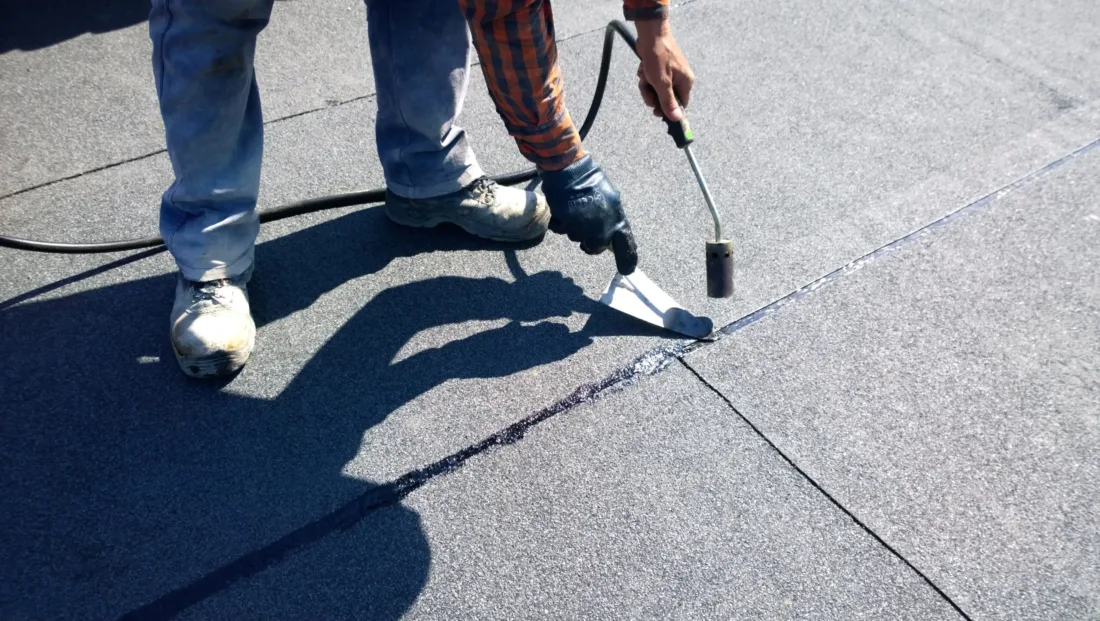
The most traditional installation method. The underside of the membrane roll is heated with a propane torch as the roll is unrolled, melting the modified asphalt on the underside and fusing it to the substrate or previous ply. Produces a strong fully-bonded membrane with watertight seams. Trade-offs: requires hot-work permits, fire safety protocols, and skilled application. Weather sensitivity is moderate, the substrate needs to be dry and the temperature warm enough to support proper torch-down. Most commonly used with APP-modified systems.
Hot-Mopped (Hot-Asphalt) Modified Bitumen
Hot asphalt from a kettle is mopped onto the substrate, and the membrane roll is unrolled into the hot asphalt while it’s still molten. The asphalt cools and bonds the membrane to the substrate. Hot-mopped application is well-suited to large-scale commercial work where the kettle setup is justified by the project size. Trade-offs include fire safety, kettle smoke and odor (which can be problematic in occupied buildings), and the same weather constraints as torch-applied.
Cold-Applied Modified Bitumen
Liquid asphalt-based adhesives are applied to the substrate, and the membrane is rolled into the adhesive. No flame, no hot kettle, no smoke. Cold-applied is the increasingly preferred application method for occupied commercial buildings, sensitive sites, and projects where fire safety is a concern. Trade-offs: longer cure times than hot or torch methods, and the cost of the cold adhesive can offset some of the labor savings.
Self-Adhered Modified Bitumen
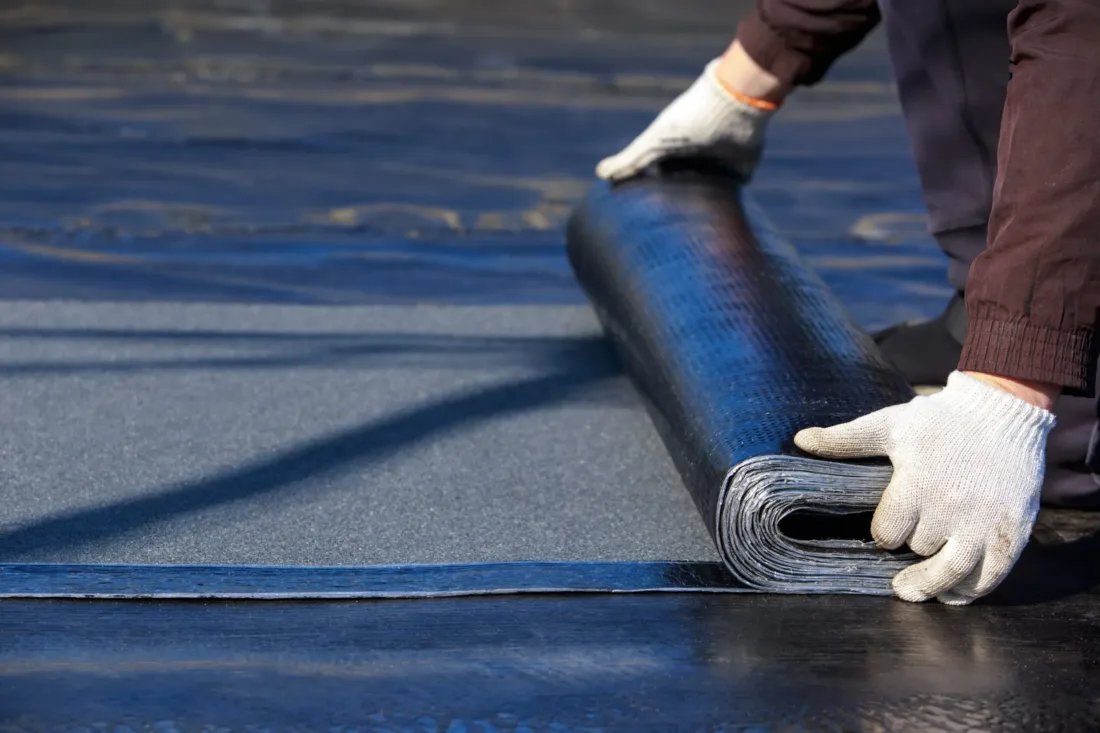
The membrane comes from the factory with a peel-and-stick adhesive on the underside. The roll is unrolled, the release liner is peeled away, and the membrane bonds directly to the prepared substrate. The cleanest, fastest, and safest application method, with no flame, smoke, or hot adhesive. Increasingly common on smaller commercial projects and on installations near sensitive operations. Trade-offs: requires precise substrate prep for proper adhesion, and material cost is typically higher than torch or hot-mop systems.
Why Modified Bitumen Still Matters for Wheat Ridge, CO Commercial Buildings
TPO and other single-plies have taken substantial market share from modified bitumen on new commercial installations, but mod-bit retains specific advantages that still make it the right answer on certain buildings.
Multi-ply redundancy.
A typical mod-bit system has two or three plies. If the cap sheet is damaged, the underlying base ply provides backup waterproofing. Single-ply systems are exactly that, single-ply, and any damage that breaches the membrane breaches the entire waterproofing layer. For commercial buildings where roof failure has high consequences (data centers, manufacturing with sensitive equipment, food storage), mod-bit’s redundancy can justify its choice over single-ply.
Foot traffic durability.
Modified bitumen’s multi-ply construction and granular cap sheet handle foot traffic substantially better than single-ply membranes. On commercial buildings with frequent rooftop access, HVAC service, equipment maintenance, satellite/antenna work, mod-bit’s traffic resistance is a genuine advantage. Walkway pads on single-ply systems address the same problem at additional cost.
Strong impact resistance.
Multi-ply asphalt systems handle hail and impact damage well. Even when the cap sheet is damaged at an impact site, the underlying ply continues to provide waterproofing while repair is scheduled. For Colorado hail exposure, this redundant impact resistance is meaningful.
Long proven track record.
Modified bitumen has 50+ years of real-world commercial roofing performance data, comparable to EPDM and PVC, longer than TPO. For property owners who value proven longevity over newer technology, mod-bit’s track record is unmatched outside of EPDM.
Strong cool-roof options available.
White granular cap sheets on modified bitumen can deliver cool-roof reflectivity competitive with white single-ply membranes. ENERGY STAR-rated mod-bit systems are widely available.
Excellent fit for re-roofing over existing BUR or mod-bit.
On older commercial buildings with existing built-up or modified bitumen roofs, applying a new mod-bit system as a recover or partial replacement preserves chemistry compatibility and avoids the substrate compatibility considerations that single-ply recover applications can introduce.
The Honest Modified Bitumen Trade-Offs
Heavier than single-ply.
Multi-ply asphalt systems weigh substantially more per square foot than single-ply membranes. On older buildings with structural load constraints, this matters. Most commercial buildings handle the load without issue, but it’s worth verifying on older or marginal structures.
More labor-intensive to install.
Multi-ply application takes longer than rolling out a single-ply membrane and welding seams. Total installed cost on mod-bit is sometimes higher than equivalent TPO, depending on application method and labor rates.
Torch-applied requires fire safety discipline.
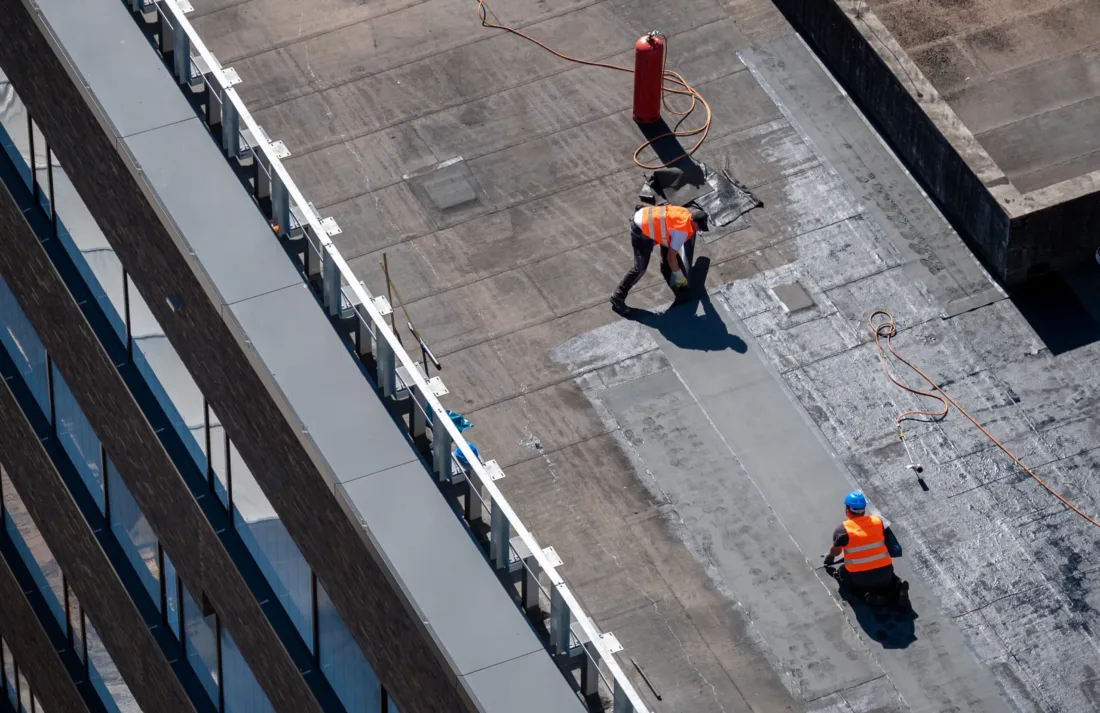
Hot-work permits, fire watch protocols, and proper torch-down technique are non-negotiable on torch-applied projects. The roofing industry’s history with torch-down work includes some preventable fires. Cold-applied and self-adhered systems eliminate this risk; torch-down requires professional execution.
Asphalt-based environmental considerations.
Modified bitumen is asphalt-based, with the manufacturing footprint and end-of-life considerations that come with petroleum-based products. Some environmentally-focused commercial projects prefer non-asphalt alternatives. Manufacturers have made progress on cold-applied formulations and recycling programs that address some of these concerns.
Hot-mopped installations can disrupt occupied buildings.
Kettle smoke, asphalt odor, and fire-safety considerations can be problematic on installations near occupied spaces. Cold-applied or self-adhered methods address this, at a cost premium.
Where Modified Bitumen Works Best in Wheat Ridge, CO
- Commercial buildings with heavy rooftop foot traffic, HVAC service, equipment maintenance, frequent access
- Properties where multi-ply redundancy is specifically valued, data centers, manufacturing, sensitive operations
- Re-roof projects over existing modified bitumen or BUR systems where chemistry compatibility matters
- Historic or traditional commercial buildings where the appearance of granular cap sheet is preferred
- Projects with hail-prone exposure where multi-ply impact resistance is valued
- Buildings where the longest possible track record is a decision factor
- Older buildings with existing asphalt-based roof assemblies where compatibility favors mod-bit
Modified bitumen is generally not the right answer for buildings where cool-roof reflectivity is the dominant priority and white TPO would cost less to install, on projects where weight is a structural concern, or where occupied-building installation noise/smoke from torch or hot-mop methods would be problematic and the cost premium for cold-applied or self-adhered systems isn’t justified.
Internal links: link to Commercial Built-Up Tar & Gravel Roofing for the BUR comparison and to Commercial TPO Roofing for the cool-roof comparison.
Modified Bitumen Roofing and Wheat Ridge, CO’s Climate
Cold weather: SBS-modified handles it well.
SBS-modified bitumen retains flexibility at low temperatures, performing well through Wheat Ridge, CO winters. APP-modified is more brittle in cold weather and is less common in the Wheat Ridge, CO market for this reason. Cold-weather installation has limits, torch-down and hot-mopped methods need adequate substrate temperatures, and cold-applied adhesives have temperature minimums.
Hail performance: among the strongest.
Multi-ply construction and the granular cap sheet give modified bitumen genuinely strong impact resistance. Hail that would puncture single-ply membranes often only damages the cap sheet on mod-bit, with the underlying plies continuing to provide waterproofing. For hail-prone Colorado buildings, this is a real practical advantage.
UV at altitude: well-handled with proper cap sheet.
Granular cap sheets protect the underlying asphalt from UV. Modern formulations from established manufacturers handle Wheat Ridge, CO’s high-altitude UV exposure well over the system’s service life. White granular surfaces additionally provide cool-roof reflectivity.
Temperature swings: handled.
SBS-modified mod-bit accommodates Wheat Ridge, CO’s daily temperature swings well due to the rubber modifier’s elasticity. APP-modified can be more vulnerable to extreme thermal cycling stress.
Foot traffic durability: a Wheat Ridge, CO advantage.
Many Wheat Ridge, CO commercial buildings have rooftop solar, HVAC equipment, and frequent service access. Modified bitumen’s foot traffic resistance is genuinely valuable on these buildings.
Frequently Asked Questions: Commercial Modified Bitumen Roofing in Wheat Ridge, CO
-
How long does a modified bitumen roof last?
Manufacturer warranties on commercial modified bitumen systems typically run 15 to 20 years on standard installations and up to 30 years on premium multi-ply systems. Real-world service life on properly installed mod-bit commonly meets or exceeds the warranty, with well-maintained systems delivering 25 to 30+ years before replacement is needed.
-
How much does modified bitumen roofing cost in Wheat Ridge, CO?
Mod-bit cost depends on application method, number of plies, modifier chemistry, granular cap sheet selection, and project size. Per square foot, mod-bit is typically priced between EPDM and PVC, often comparable to TPO depending on specifications. Self-adhered installations are typically the most expensive; torch-applied and hot-mopped are typically lower-cost depending on project access and crew availability.
-
Modified bitumen vs. TPO: which is better?
It depends on the application. TPO is typically the better choice for general commercial buildings with priority on cool-roof reflectivity and competitive cost. Modified bitumen is typically the better choice for buildings with heavy foot traffic, applications where multi-ply redundancy matters, hail-prone exposure where impact resistance matters, and re-roof projects over existing asphalt-based systems. Our inspection and the building’s specific use will tell us which fits better.
-
Should I choose SBS or APP modified bitumen for my Wheat Ridge, CO building?
For most Wheat Ridge, CO commercial applications, SBS-modified bitumen is the better fit. SBS handles Wheat Ridge, CO’s cold winters and temperature swings substantially better than APP. APP can be appropriate on specific applications with heavy solar exposure where the harder, more plastic-like membrane offers advantages, but SBS is the default for the Wheat Ridge, CO market.
-
Is torch-down installation safe for my building?
With professional execution, yes. Torch-down requires hot-work permits, fire watch protocols, and proper torch technique, all standard parts of professional commercial torch-down work. For occupied buildings, hospitals, schools, and projects where fire safety has elevated importance, cold-applied or self-adhered modified bitumen eliminates the torch-down fire concerns entirely. We’ll recommend the application method that fits your specific project.
-
Does modified bitumen qualify for ENERGY STAR or cool-roof rebates?
Modified bitumen with white granular cap sheets carries ENERGY STAR ratings on most major manufacturer products and meets cool-roof code requirements where applicable. Specific rebates and tax incentives vary by program, year, and jurisdiction, talk to your tax advisor or local utility about what’s currently available.
-
Can modified bitumen be installed over my existing commercial roof?
In some cases, yes. Mod-bit can be installed as a recover system over existing built-up, modified bitumen, or certain other substrates when the existing system is sound and code allows it. Recover applications are often particularly attractive on older commercial buildings with existing asphalt-based roofs because chemistry compatibility is straightforward. Our inspection will tell you whether recover fits your building or whether tear-off and replacement makes more sense.
Get a Commercial Modified Bitumen Roofing Estimate in Wheat Ridge, CO
Whether you need a new modified bitumen roof installed, an existing roof replaced or recovered, or a comparison between mod-bit and other commercial roofing systems for your specific application, Baseline Roofing and Solar is ready to help. We install SBS and APP systems using all four primary application methods (torch-applied, hot-mopped, cold-applied, and self-adhered). And we specify the system and method that fits your building rather than the one we happen to install most often.
-
More Modified-Bitumen Roofing Locations +
- Modified-Bitumen Roofing in Colorado
- Modified-Bitumen Roofing in Arvada, CO
- Modified-Bitumen Roofing in Aurora, CO
- Modified-Bitumen Roofing in Berthoud, CO
- Modified-Bitumen Roofing in Boulder, CO
- Modified-Bitumen Roofing in Brighton, CO
- Modified-Bitumen Roofing in Broomfield, CO
- Modified-Bitumen Roofing in Castle Pines, CO
- Modified-Bitumen Roofing in Castle Rock, CO
- Modified-Bitumen Roofing in Centennial, CO
- Modified-Bitumen Roofing in Cherry Creek, CO
- Modified-Bitumen Roofing in Cherry Hills Village, CO
- Modified-Bitumen Roofing in Colorado Springs, CO
- Modified-Bitumen Roofing in Commerce City, CO
- Modified-Bitumen Roofing in Englewood, CO
- Modified-Bitumen Roofing in Erie, CO
- Modified-Bitumen Roofing in Firestone, CO
- Modified-Bitumen Roofing in Fort Collins, CO
- Modified-Bitumen Roofing in Frederick, CO
- Modified-Bitumen Roofing in Golden, CO
- Modified-Bitumen Roofing in Greeley, CO
- Modified-Bitumen Roofing in Greenwood Village, CO
- Modified-Bitumen Roofing in Gunbarrel, CO
- Modified-Bitumen Roofing in Highlands Ranch, CO
- Modified-Bitumen Roofing in Lafayette, CO
- Modified-Bitumen Roofing in Lakewood, CO
- Modified-Bitumen Roofing in Littleton, CO
- Modified-Bitumen Roofing in Lone Tree, CO
- Modified-Bitumen Roofing in Longmont, CO
- Modified-Bitumen Roofing in Louisville, CO
- Modified-Bitumen Roofing in Loveland, CO
- Modified-Bitumen Roofing in Mead, CO
- Modified-Bitumen Roofing in Niwot, CO
- Modified-Bitumen Roofing in Northglenn, CO
- Modified-Bitumen Roofing in Parker, CO
- Modified-Bitumen Roofing in Superior, CO
- Modified-Bitumen Roofing in Thornton, CO
- Modified-Bitumen Roofing in Westminster, CO
- Modified-Bitumen Roofing in Wheat Ridge, CO
- Modified-Bitumen Roofing in Windsor, CO