Commercial PVC Roofing in Castle Pines, CO
Polyvinyl Chloride single-ply membrane, known throughout the roofing industry as PVC roofing, is the specialist’s commercial single-ply system. While TPO has become the default choice for most general commercial buildings and EPDM has its own niche on thermal-cycling-heavy applications, PVC owns a specific category of commercial roofs where it’s not just the right choice. It’s effectively the only acceptable choice. Anywhere rooftop exhaust contains grease, animal fats, chemicals, or industrial process vapors, PVC is the membrane that handles it. For Castle Pines, CO’s restaurants, food service buildings, manufacturing facilities, and any commercial property where rooftop exhaust attacks ordinary roofing materials, PVC is the answer.
Baseline Roofing and Solar installs commercial PVC roofing systems across Castle Pines, CO and surrounding Colorado communities. We’re certified to install PVC from every major commercial manufacturer (Carlisle/Sika Sarnafil, Versico, GAF, Mule-Hide, IB, Johns Manville, and others). PVC formulations and warranty programs vary substantially between manufacturers, and getting the right system for your specific application is part of why manufacturer-certified specification matters on PVC projects.
On this page. We’ll explain what PVC actually is, why it’s the chemical-resistance specialist among commercial single-plies, where PVC is genuinely the right answer (and where it’s not), the installation methods, the honest trade-offs (including the plasticizer chemistry that’s central to PVC’s behavior over time), and how PVC compares to its closest cousin, TPO.
What PVC Roofing Actually Is
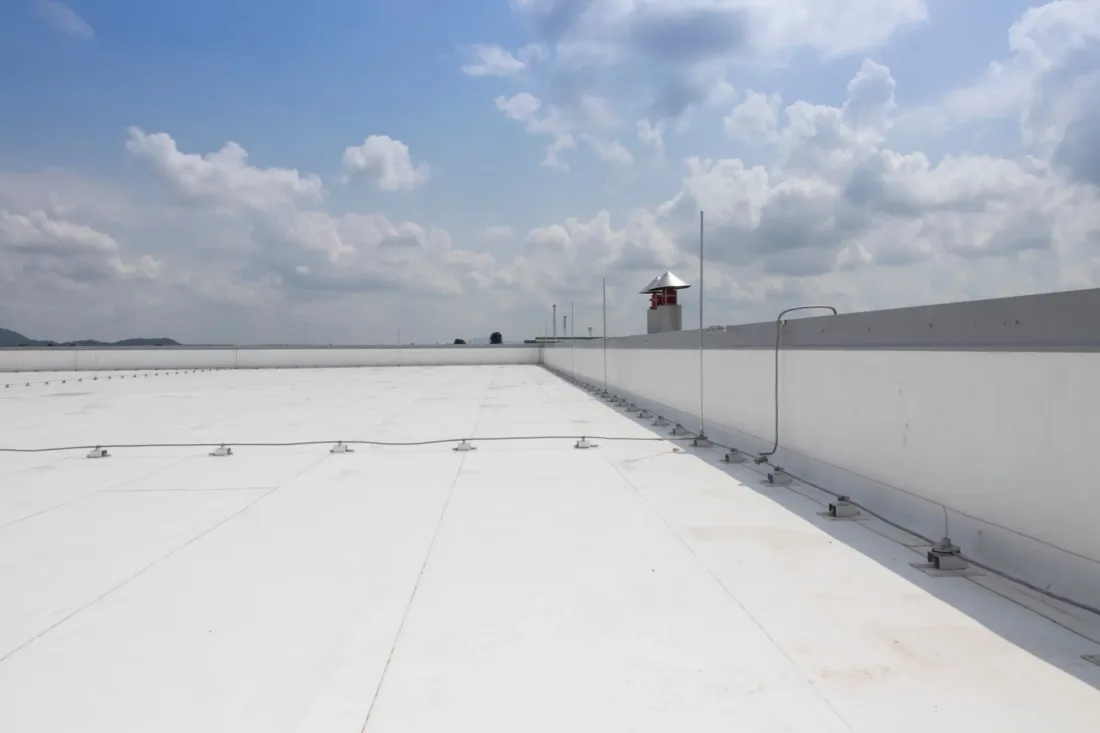
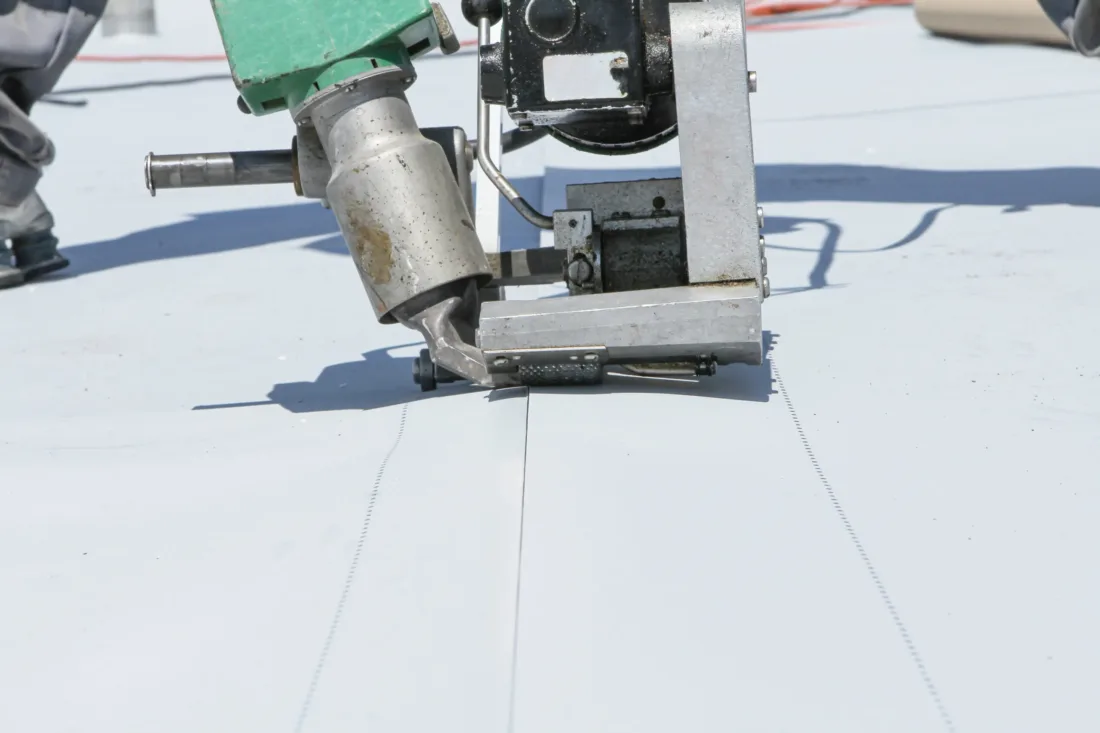
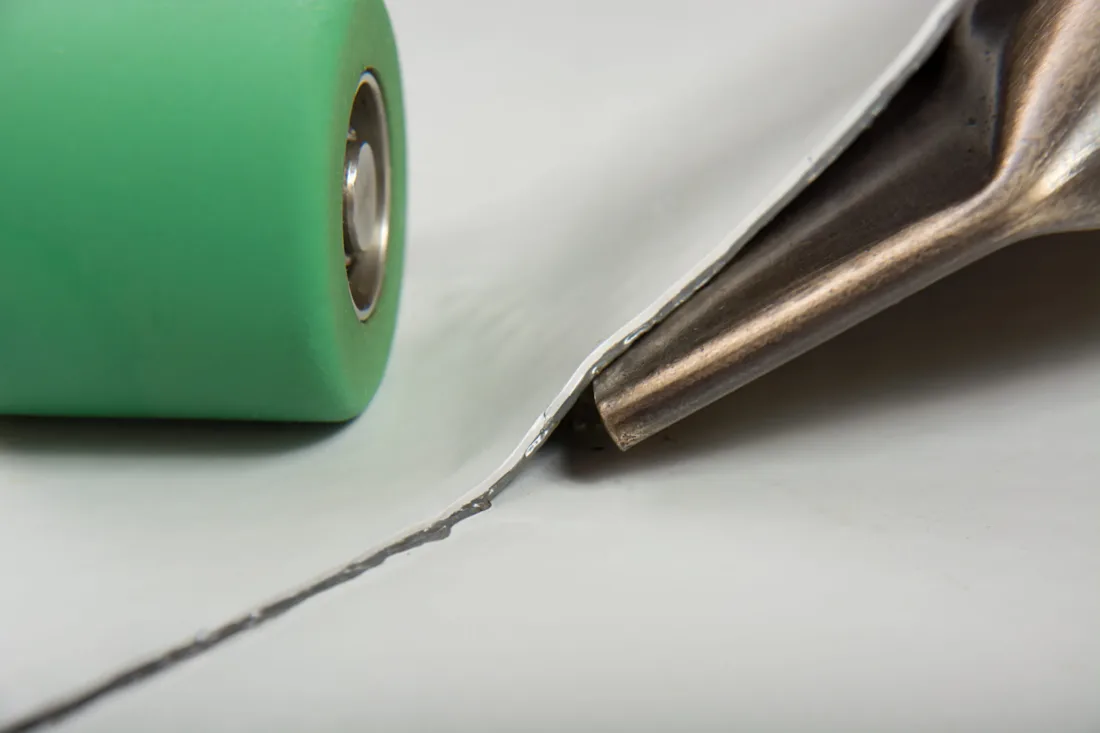
PVC roofing membrane is a single-ply thermoplastic membrane manufactured from polyvinyl chloride resin combined with plasticizers (which keep the material flexible at temperature), stabilizers (which protect against UV and heat), and a polyester reinforcement scrim that gives the membrane its tensile strength and tear resistance. Like TPO, PVC is a thermoplastic, meaning seams are joined with hot-air welders that fuse the membrane plies together at the molecular level, creating continuous monolithic seams that are typically stronger than the membrane itself when properly welded.
PVC has a longer commercial roofing history than TPO. It’s been installed on commercial buildings since the 1960s and has a proven track record across decades of real-world performance. Modern formulations have improved on early-generation PVC, particularly around plasticizer chemistry that affects long-term flexibility, which we’ll cover in the trade-offs section because it’s the most important honest point about PVC.
PVC is most commonly bright white, with high solar reflectance values that qualify for ENERGY STAR ratings. PVC is also widely available in colors, gray, tan, terracotta, even custom colors, that aren’t typically practical with TPO. For projects where the roof is visible from grade (multi-story buildings, architecturally exposed roofs), PVC’s color flexibility is sometimes meaningful.
Why PVC Is the Chemical-Resistance Specialist
PVC’s headline property, the one that makes it the only acceptable choice on certain commercial buildings, is chemical resistance. Specifically, PVC stands up to:
- Animal fats and grease. Restaurant exhaust deposits airborne grease on the roof around exhaust hoods. Standard single-ply membranes (TPO and EPDM) degrade under prolonged grease exposure, the membrane softens, loses physical properties, and eventually fails. PVC is essentially immune to grease attack. This is the single most common scenario where PVC is non-negotiable.
- Chemical exhaust and process vapors. Manufacturing facilities, plating shops, chemical plants, dry cleaners, and many industrial buildings discharge vapors that attack ordinary roofing materials. PVC’s chemical resistance profile handles a much wider range of these exposures than TPO or EPDM.
- Petroleum products and oils. Vehicle service, equipment service, and similar applications can drip or expose the roof to oils that degrade other membranes. PVC handles oil exposure substantially better.
- Bird droppings (yes, really). On buildings with significant bird activity, the uric acid in droppings can accelerate degradation of TPO and EPDM. PVC is more resistant. This is occasionally a real factor on commercial buildings near roosting areas.
- Stronger fire resistance than other single-plies. PVC has inherent flame-retardant properties from its chlorine chemistry, giving it generally better fire performance than TPO or EPDM. On commercial buildings where fire-rating requirements are strict, PVC is sometimes the simplest path to compliance.
None of this means PVC is universally better than TPO or EPDM. For general commercial buildings without specific chemical exposure, TPO is usually a better economic choice. But on buildings with the conditions above, PVC is the right call by a wide margin.
Where PVC Roofing Is Genuinely the Right Answer
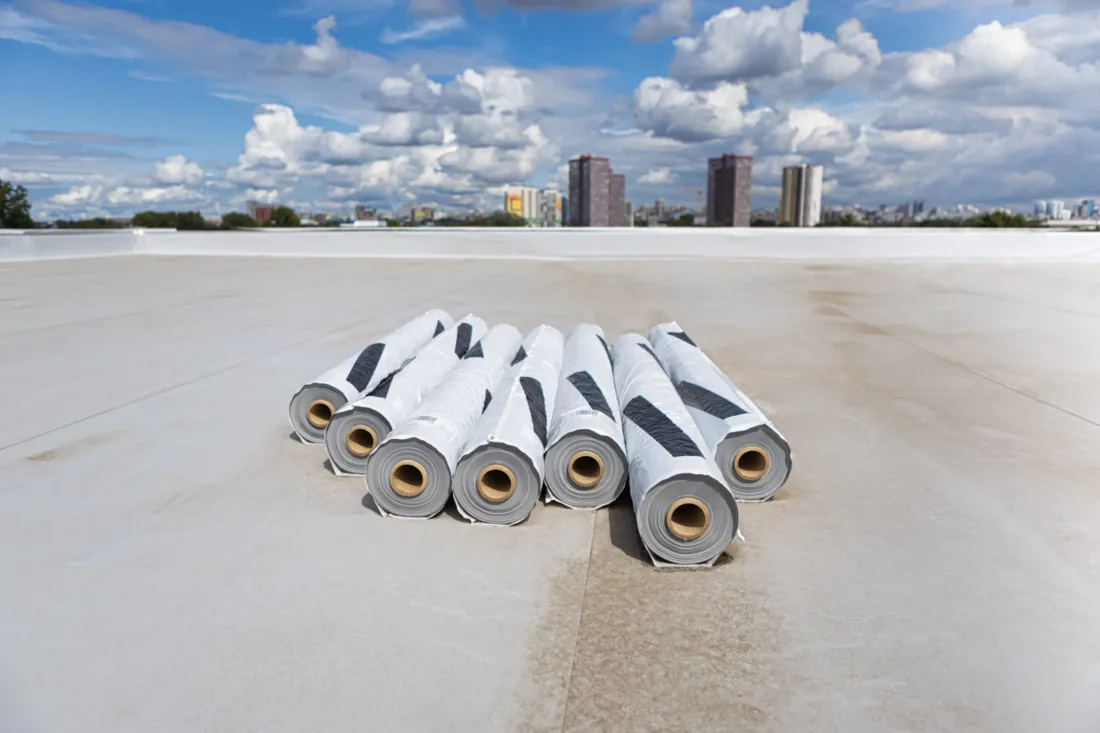
Specific commercial applications where we recommend PVC almost without exception:
Restaurants and food service buildings.
Rooftop exhaust from kitchen hoods, grease ducts, and food preparation equipment makes PVC the standard for any building with a commercial kitchen. This includes standalone restaurants, restaurants in retail centers, hotel restaurant operations, school and corporate cafeterias, and food courts.
Food processing and manufacturing.
Bakeries, meat processing facilities, dairy operations, and any building where animal fats or food-grade oils are processed. PVC handles these conditions; TPO and EPDM don’t, long-term.
Auto service buildings and dealerships.
Service bays, oil change facilities, and dealerships with vehicle service operations expose roofs to oils and petroleum vapors that PVC handles well.
Manufacturing facilities.
Chemical processing, plating operations, and industrial buildings with rooftop exhaust of any kind generally specify PVC for chemical compatibility.
Buildings with strict fire-rating requirements.
Where local code or insurance requirements drive fire-resistance demands, PVC’s inherent flame-retardant properties simplify compliance.
Architecturally exposed commercial roofs.
Where the roof color is visible and matters, PVC’s broad color availability fits projects that white TPO doesn’t.
PVC is generally not the right answer for general commercial warehouses, offices, retail buildings without food service, or any building where its premium price isn’t justified by specific chemical-exposure requirements. On those buildings, TPO usually delivers comparable performance at a meaningfully lower cost.
PVC Installation Methods
PVC installs using the same three primary methods as TPO, with similar trade-offs.
Mechanically-Fastened PVC
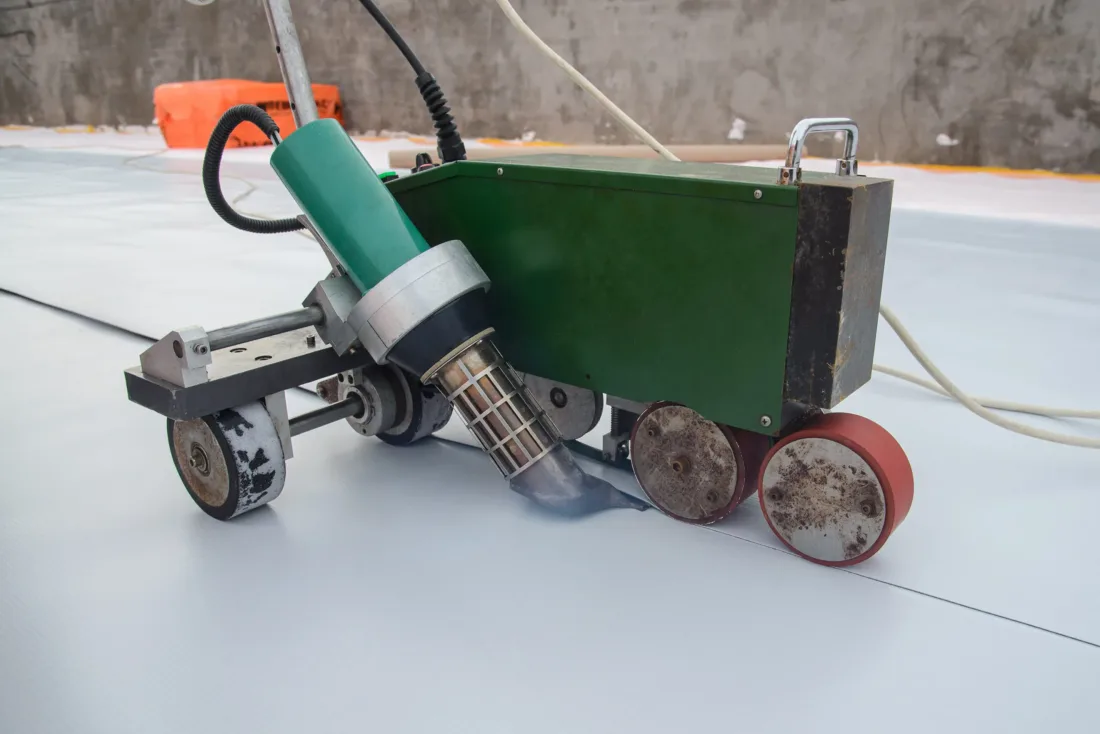
Insulation board fastened to the deck, then PVC membrane unrolled over the insulation and fastened along the seams with plates and screws. The next sheet of PVC is heat-welded over the fastener plates, sealing them in. The most common and cost-effective installation method, well-suited to most commercial buildings.
Fully-Adhered PVC
Insulation mechanically-fastened to the deck, then both the insulation top and PVC underside are coated with manufacturer-approved adhesive and the membrane is rolled into place. Produces the strongest wind-uplift performance and the cleanest installation, with no fastener penetrations through the membrane. Premium installation method, cost premium over mechanically-fastened, requires good weather for adhesive cure.
Induction-Welded PVC
Hybrid method that combines mechanical fastening efficiency with adhered-system holding strength. Specialized fastener plates are installed below the membrane, and the membrane is welded to the plates from above using induction equipment. Strong wind-uplift, fast install, no membrane fastener penetrations. Increasingly popular for hail-prone Castle Pines, CO applications.
The Honest PVC Trade-Offs
PVC has real trade-offs. We’d rather flag them clearly than have you discover them after installation.
Plasticizer migration over time.
This is the central honest point about PVC chemistry. PVC requires plasticizers to remain flexible at temperature, and plasticizers can slowly migrate out of the membrane over decades of service. As plasticizers leave, the membrane gradually loses flexibility and can become brittle in extreme cold or under impact stress. Modern PVC formulations use higher-molecular-weight plasticizers that migrate much more slowly than early-generation products, but the chemistry trade-off is inherent to PVC. This is why aged PVC roofs sometimes show seam-edge brittleness or impact damage that wouldn’t affect a younger membrane.
Higher cost than TPO and EPDM.
Per square foot of installed material, PVC is typically the most expensive of the three single-ply options. The premium can be 20-40% over equivalent TPO depending on system specifications and manufacturer. The premium is justified when chemical exposure or fire requirements demand PVC. It isn’t justified on buildings where TPO would perform identically.
Compatibility limitations.
PVC is incompatible with many petroleum-based materials at the substrate level, it reacts with asphalt-based products, certain insulation facers, and some adhesives. Proper substrate isolation (separator sheets, manufacturer-approved primers) is required when installing PVC over or adjacent to incompatible materials. Skipping these compatibility considerations causes premature failures.
Environmental considerations.
PVC manufacturing involves chlorine chemistry, and end-of-life disposal of PVC roofing has environmental considerations that don’t affect TPO or EPDM in the same way. For projects where environmental footprint of materials is a decision factor, TPO or EPDM may be preferred where they meet performance requirements. Many manufacturers now offer PVC products with recycling programs that address some of these concerns.
PVC vs. TPO: How to Choose Between the Heat-Welded Single-Plies
Since both PVC and TPO are heat-welded thermoplastic single-plies with similar installation methods, the comparison comes down to specific performance and cost factors.
Choose PVC when:
- There’s any rooftop exhaust containing grease, oil, animal fats, or chemicals
- The building is a restaurant, food service, manufacturing, or industrial facility
- Strict fire-rating requirements are in play
- Color flexibility (non-white) is needed
- The longest manufacturer warranty terms are required
- Chemical resistance is the dominant decision factor
Choose TPO when:
- The building doesn’t have specific chemical exposure
- Cost-effectiveness matters and TPO performance is sufficient
- White cool-roof reflectivity is the priority
- New construction with budget pressure
- General commercial applications, warehouses, offices, retail, schools, distribution
On a typical Castle Pines, CO commercial property without food service, manufacturing, or specific chemical exposure, TPO will almost always be the better economic choice. On a Castle Pines, CO restaurant with full kitchen exhaust or an industrial manufacturing facility with chemical vapors, PVC is the right answer regardless of the cost premium.
PVC Roofing and Castle Pines, CO’s Climate
High-altitude UV: well-handled.
Modern PVC formulations with proper UV stabilizers handle Castle Pines, CO’s high-altitude UV exposure well over their service life. PVC’s track record at elevation is solid.
Hail performance: comparable to TPO.
60-mil and 80-mil PVC handle Colorado hail similarly to equivalent TPO thicknesses. Reinforced and impact-rated PVC products offer additional protection on hail-prone applications. Proper thickness selection is essential for Castle Pines, CO buildings.
Temperature swings: strong performance in modern formulations.
Modern PVC handles Castle Pines, CO’s temperature swings well, but this is one area where the plasticizer-migration trade-off matters most. Aged PVC can become more brittle in extreme cold than aged TPO or EPDM. New PVC formulations with high-molecular-weight plasticizers minimize this issue.
Cool-roof reflectivity: excellent.
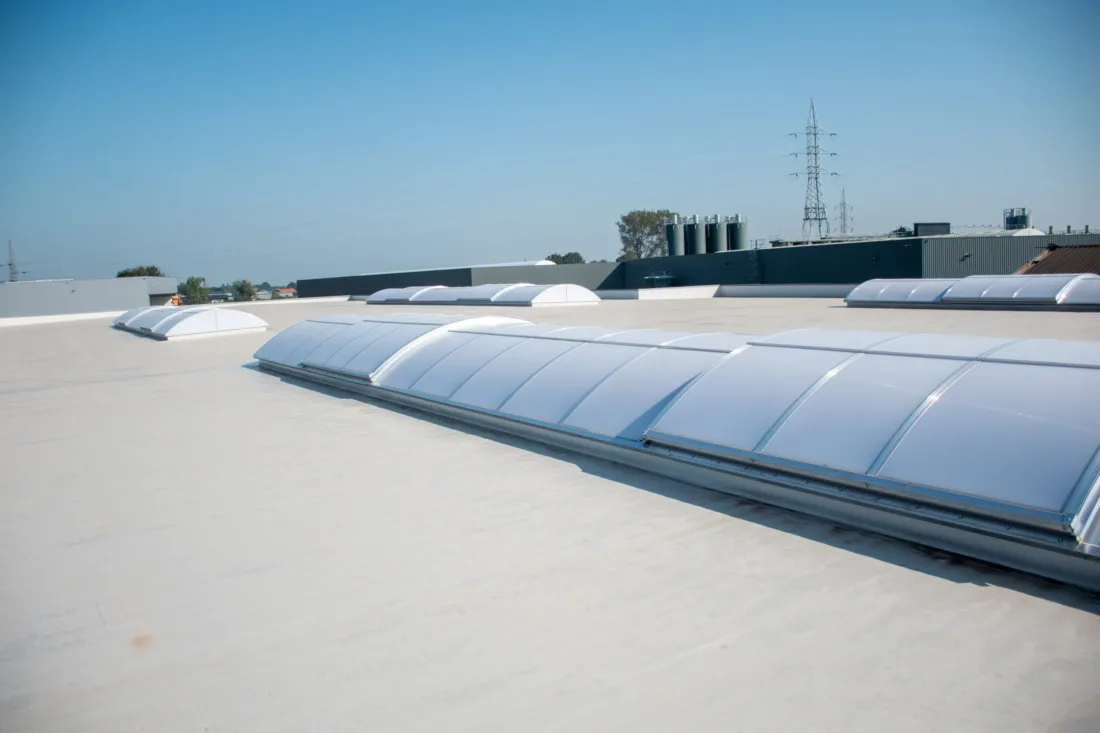
White PVC carries reflectance values comparable to white TPO and qualifies for ENERGY STAR ratings on most major systems. Cool-roof energy savings on PVC roofs in Castle Pines, CO are substantial.
Wind exposure: excellent with proper installation method.
Like TPO, PVC’s wind-uplift performance depends on installation method. Mechanically-fastened systems perform to engineered fastener pattern; fully-adhered and induction-welded systems handle high-wind exposure with no membrane penetrations.
Frequently Asked Questions: Commercial PVC Roofing in Castle Pines, CO
-
How long does a PVC roof last in Castle Pines, CO?
Manufacturer warranties on commercial PVC typically run 20 to 30 years depending on membrane thickness and warranty type. Real-world service life on properly installed PVC commonly meets or exceeds the warranty. Older PVC formulations sometimes show plasticizer-migration issues at advanced age; modern formulations have largely addressed this through improved plasticizer chemistry.
-
Is PVC really the only acceptable roof for restaurants?
In effect, yes, for buildings with active commercial kitchen exhaust. TPO and EPDM degrade under grease and animal fat exposure, leading to premature failure on restaurants. Most commercial roofing manufacturers will not warranty TPO or EPDM installations adjacent to grease exhaust. PVC is essentially immune to grease attack and is the industry standard for food service applications.
-
How much does PVC roofing cost compared to TPO in Castle Pines, CO?
PVC typically costs 20-40% more per square foot than equivalent TPO, depending on membrane thickness, manufacturer, and installation method. The cost premium is justified by chemical resistance on applications that need it; on general commercial buildings without those needs, the premium isn’t worth paying.
-
What is plasticizer migration and should I worry about it?
Plasticizers are additives that keep PVC flexible. Over decades of service, they can slowly migrate out of the membrane, gradually reducing flexibility. Modern PVC products use higher-molecular-weight plasticizers that migrate much more slowly than early-generation products. On a properly specified modern PVC roof, plasticizer migration is unlikely to affect performance during the warranty period, though it remains a chemistry-level consideration for very long service applications.
-
What thickness of PVC should I install?
60-mil is the commercial standard and our most-recommended thickness for typical Castle Pines, CO commercial buildings, with 80-mil specified on hail-prone or high-traffic applications. 50-mil is the budget option for protected applications. We don’t typically recommend the thinnest options for Castle Pines, CO applications.
-
Does PVC roofing qualify for ENERGY STAR or cool-roof rebates?
Most major manufacturers’ white PVC membranes carry ENERGY STAR ratings and meet cool-roof code requirements. Specific rebates and tax incentives vary by program, year, and jurisdiction, talk to your tax advisor or local utility about what’s currently available.
-
Can PVC be installed over my existing roof?
In some cases, yes, but compatibility considerations are particularly important on PVC. PVC is incompatible with asphalt-based substrates and some other materials, requiring proper separator sheets or substrate preparation. On many recover applications, our inspection determines whether PVC is suitable or whether a different system or full tear-off makes more sense.
Get a Commercial PVC Roofing Estimate in Castle Pines, CO
Whether you operate a restaurant or food service facility, a manufacturing or industrial building, or any commercial property where rooftop exhaust includes grease, oils, or chemicals, PVC is likely the right roof system for your building. Baseline Roofing and Solar specifies and installs commercial PVC roofing systems across Castle Pines, CO and surrounding Colorado communities, with manufacturer certifications across every major PVC manufacturer and the technical expertise to handle the substrate compatibility considerations that matter on PVC projects.
-
More PVC Roofing Locations +
- PVC Roofing in Colorado
- PVC Roofing in Arvada, CO
- PVC Roofing in Aurora, CO
- PVC Roofing in Berthoud, CO
- PVC Roofing in Boulder, CO
- PVC Roofing in Brighton, CO
- PVC Roofing in Broomfield, CO
- PVC Roofing in Castle Pines, CO
- PVC Roofing in Castle Rock, CO
- PVC Roofing in Centennial, CO
- PVC Roofing in Cherry Creek, CO
- PVC Roofing in Cherry Hills Village, CO
- PVC Roofing in Colorado Springs, CO
- PVC Roofing in Commerce City, CO
- PVC Roofing in Englewood, CO
- PVC Roofing in Erie, CO
- PVC Roofing in Firestone, CO
- PVC Roofing in Fort Collins, CO
- PVC Roofing in Frederick, CO
- PVC Roofing in Golden, CO
- PVC Roofing in Greeley, CO
- PVC Roofing in Greenwood Village, CO
- PVC Roofing in Gunbarrel, CO
- PVC Roofing in Highlands Ranch, CO
- PVC Roofing in Lafayette, CO
- PVC Roofing in Lakewood, CO
- PVC Roofing in Littleton, CO
- PVC Roofing in Lone Tree, CO
- PVC Roofing in Longmont, CO
- PVC Roofing in Louisville, CO
- PVC Roofing in Loveland, CO
- PVC Roofing in Mead, CO
- PVC Roofing in Niwot, CO
- PVC Roofing in Northglenn, CO
- PVC Roofing in Parker, CO
- PVC Roofing in Superior, CO
- PVC Roofing in Thornton, CO
- PVC Roofing in Westminster, CO
- PVC Roofing in Wheat Ridge, CO
- PVC Roofing in Windsor, CO