Commercial Flat Roof Installation in Arvada, CO
A new commercial flat roof, whether it’s the first roof on a brand-new building or a freshly installed system replacing one that’s reached the end of its life, is one of the largest line items on any commercial construction project. The quality of that installation determines whether the system performs to its full design life or starts causing problems years ahead of schedule. Commercial flat roof installation in Arvada, CO demands a contractor who understands single-ply membranes, multi-ply asphalt systems, sprayed-in-place foam, manufacturer specifications, Colorado building code, and the specific climate stressors of Colorado.
Baseline Roofing and Solar is a Colorado-based commercial roofing contractor that handles flat roof installations for new construction projects, tenant improvement work, and re-roof installations across Arvada, CO and surrounding Colorado communities. We work directly with general contractors, architects, building owners, and developers from system specification through final inspection. Our crews are certified by every major commercial roofing manufacturer, Carlisle, Versico, GAF, Mule-Hide, Firestone, Johns Manville, and others, which means we can install whichever system the project specifies, to the exact standards required to register the manufacturer’s long-term warranty.
On this page. We’ll walk through what good commercial flat roof installation actually looks like, who we work with on new construction and re-roof projects, the systems we install most often, and the step-by-step process from specification through commissioning.
When Commercial Flat Roof Installation Comes Into Play
“Installation” covers more than one scenario in commercial roofing. Most projects we handle fall into one of the following categories:
New Construction
A brand-new commercial building under construction needs a roof installed for the first time. We coordinate with the general contractor, architect, and other trades to install the roof system at the right point in the construction sequence, after the deck is in place and dry-in is required, but coordinated with HVAC, electrical, and other rooftop work.
Tenant Improvements and Building Additions
New roof sections are required when buildings are expanded, when additions tie into existing structures, or when a tenant improvement project changes the roof footprint. These projects demand careful detailing where the new roof meets the existing one, with flashings and transitions that are watertight under Arvada, CO weather conditions.
Re-Roof Installation After Tear-Off
After an existing commercial roof has been removed in a replacement project, the actual installation of the new system uses the same craft and the same standards as a new construction install. The systems, materials, and manufacturer specifications are identical. The only difference is the project context.
Recover Installation (Roof-Over)
When code allows and the existing system is sound, a new roof can be installed directly over the existing one. Recover installations are faster and less disruptive than tear-off and replacement. And we install recover systems regularly across Arvada, CO and the surrounding area.
Who We Install For: Partners on New Construction and Beyond
Commercial roof installation is rarely a contractor-and-owner conversation. Most projects involve multiple stakeholders. And we work fluently with all of them across Arvada, CO and surrounding Colorado communities.
General contractors.
On new construction projects, we work as a roofing subcontractor reporting to the GC. We bid competitively, hit project schedules, coordinate cleanly with other trades, and document our work for the GC’s project records. We carry the certificates of insurance and licensing GCs require. And we communicate proactively when conditions on the roof affect adjacent trades.
Architects and engineers.
On larger projects, we engage early with architects and building engineers to confirm system specifications, R-value requirements, drainage design, and details around penetrations, parapets, and edge metal. When a specified system has a better alternative for the building’s actual conditions, we flag it before bid, saving budget and improving long-term performance.
Commercial property owners and developers.
On owner-direct projects, we work with the property owner or development team from system selection through close-out. We translate manufacturer specifications and code requirements into plain language so owners can make informed decisions. And we document the project at every stage.
Property management firms.
Multi-property managers in Arvada, CO and across Colorado bring us in to install roofs across portfolios, both on planned re-roof projects and on capital improvement programs. We can scale to portfolio-level work and we’re comfortable with the documentation, communication, and reporting that property managers require.
Insurance and storm-driven projects.
After major hail or storm events, many commercial property owners need new roofs installed under insurance claims. We install to the scope approved by the carrier and document everything so the owner has a clean record for any future questions.
Commercial Flat Roof Systems We Install in Arvada, CO
Because we’re certified across every major commercial roofing manufacturer, we install whatever system best fits the project. Below are the systems we install most often on commercial buildings across Arvada, CO and the surrounding area.
TPO (Thermoplastic Polyolefin)
Single-ply membrane installed mechanically-fastened, fully-adhered, or with induction-welded plates depending on the project. White TPO offers strong reflectivity for Arvada, CO’s intense summer UV and is the most-installed commercial single-ply system in Arvada, CO right now.
EPDM (Ethylene Propylene Diene Monomer)
Single-ply rubber membrane available in fully-adhered, mechanically-fastened, or ballasted configurations. EPDM handles Arvada, CO’s massive temperature swings exceptionally well and offers proven long-term performance.
PVC (Polyvinyl Chloride)
Heat-welded single-ply membrane with superior chemical and grease resistance. The right choice for restaurants, food service buildings, manufacturing facilities, and any building with rooftop exhaust that would degrade other membranes.
Modified Bitumen
Multi-ply asphalt-based system with SBS or APP modifiers. Installed by torch-down, cold-applied, or self-adhering methods depending on the building, occupancy, and access. A workhorse system for buildings with heavy rooftop foot traffic.
Built-Up Roofing (BUR / Tar & Gravel)
Multi-ply asphalt and ply sheet system finished with a gravel surface for UV protection and impact resistance. A traditional commercial roofing standard with proven longevity.
Spray Polyurethane Foam (SPF)
Sprayed-in-place liquid foam that expands and cures into a seamless, fully-adhered, insulating roof surface. Outstanding R-value per inch and excellent for re-roof projects on irregular roof shapes or buildings with extensive rooftop equipment.
Roof Coatings
Silicone, acrylic, and elastomeric coatings extend the life of existing roof systems and can be installed as part of a planned maintenance program. We apply coatings to extend service life, restore reflectivity, and address minor surface issues.
What Good Commercial Flat Roof Installation Actually Looks Like
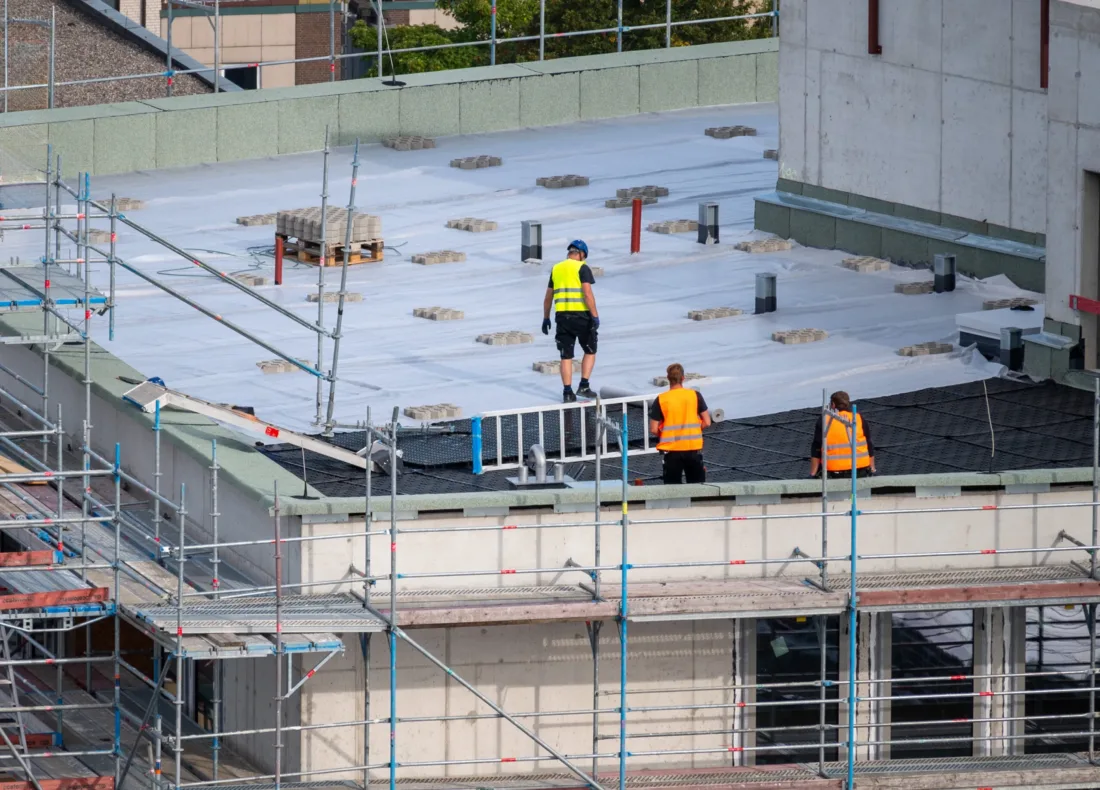
Most commercial flat roofs that fail prematurely don’t fail because the wrong material was specified, they fail because the installation cut corners. Here are the details that separate a good installation from a problematic one. We hold ourselves to all of them.
The deck and substrate are clean, dry, and prepared correctly.
Membranes installed over wet, dirty, or improperly prepared decks fail. We confirm substrate condition before any system goes down.
Insulation is installed to the design R-value with proper coverage.
Gaps, voids, and wrong-thickness insulation create thermal bridges that condense moisture and degrade performance. We install insulation to specification and verify coverage before the membrane goes down.
Tapered insulation directs water to drains.
On low-slope roofs, tapered insulation systems eliminate ponding water, which is one of the leading causes of premature commercial roof failure. We design and install taper systems specifically for the building’s drainage.
Seams are heat-welded or correctly bonded, and tested.
On TPO and PVC, seams are heat-welded and probe-tested. On EPDM, seams use manufacturer-specified tapes or adhesives applied at the right temperature. Seam quality is the single biggest predictor of long-term watertightness.
Penetrations, drains, and equipment curbs are flashed correctly.
Every penetration through the roof, pipes, vents, HVAC curbs, conduit, drains, skylights, needs to be flashed to manufacturer specification. We use the manufacturer’s prefab boots, target sheets, or field-fabricated flashings as appropriate.
Edge metal and parapet details meet wind-uplift code.
Edge metal, gravel stops, parapet caps, and termination bars are installed to ANSI/SPRI ES-1 wind-uplift standards and to the building’s actual exposure category. This is where wind takes commercial roofs apart when contractors cut corners.
The installation matches the manufacturer’s published specification.
Manufacturer warranties are only valid when the installation matches the manufacturer’s specification, fastener patterns, adhesive coverage rates, primer use, seam widths, the works. We install to spec because that’s what protects the warranty and the building.
The Commercial Flat Roof Installation Process at Baseline
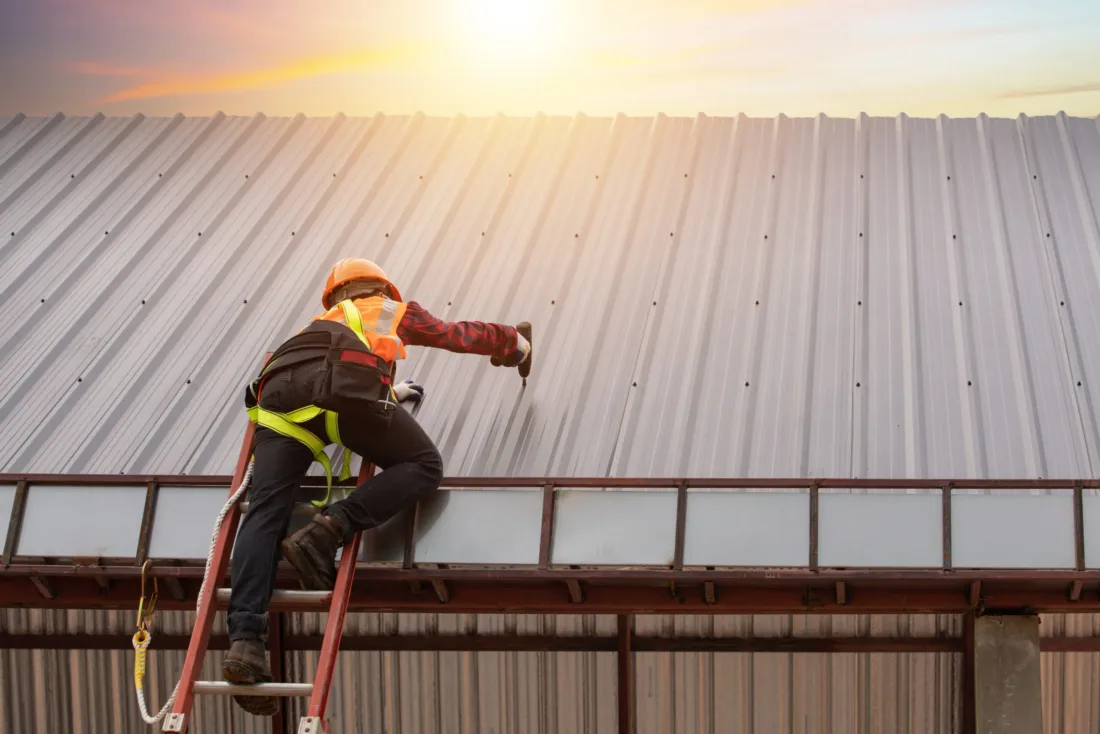
Whether your project is new construction, a re-roof installation, or a building addition, the installation process follows a clear sequence.
- Pre-installation review. We review the architect’s specification, manufacturer requirements, and the building’s specific conditions, deck type, slope, drainage, R-value requirements, wind exposure, occupancy.
- Material delivery and staging. Materials are delivered to the site at the right point in the construction sequence. We stage them to protect them from weather and to keep the building site clean and accessible.
- Substrate preparation. The deck is inspected and confirmed clean, dry, and ready for the system. Any substrate issues are addressed before installation begins.
- Insulation installation. Rigid insulation is installed to the design R-value. Tapered insulation is installed where slope to drains needs to be improved or established.
- Air and vapor barriers (where required). For buildings where the energy code or design calls for an air barrier or vapor barrier under the membrane, this layer is installed and properly sealed at all penetrations and transitions.
- Membrane or coating installation. The roofing system is installed per manufacturer specification. Single-ply membranes are heat-welded, fully-adhered, or mechanically-fastened. Multi-ply systems are torched, mopped, or self-adhered. SPF is sprayed in measured passes.
- Flashings, terminations, and details. Every penetration, parapet, drain, and edge is detailed using manufacturer-approved methods and materials.
- Quality control inspection. Before close-out, we inspect the entire installation against manufacturer requirements, probe-test seams where applicable, and confirm every detail is right.
- Manufacturer inspection (where required). For long-term warranties, the manufacturer’s inspector reviews the installation before issuing the warranty. We accompany them and address anything they flag.
- Documentation and warranty registration. We document the installation, register the manufacturer warranty in your name, and provide our workmanship warranty in writing.
Why Arvada, CO Builds and Property Owners Trust Baseline With Installation
Manufacturer-certified across every major brand.
We can install whatever system the project specifies, Carlisle, Versico, GAF, Mule-Hide, Firestone, Johns Manville, and others, to manufacturer-spec requirements that protect long-term warranties.
Owner-led project oversight.
Baseline’s owner has more than 15 years in the roofing industry and is involved in every commercial installation project. That oversight means installation quality stays consistent project to project, not just on the first job.
Coordinated, clean installation.
On new construction sites, our crews keep the work area organized, communicate proactively with the GC’s superintendent, and don’t create problems for adjacent trades. On owner-direct projects, we keep the site presentable and the building accessible throughout.
Proactive scheduling.
Roof installations live and die on weather windows in Colorado. We watch forecasts closely, communicate schedule changes early, and don’t install wet roofs to make a date. Doing it right is cheaper than doing it twice.
Frequently Asked Questions: Commercial Flat Roof Installation in Arvada, CO
-
How long does a commercial flat roof installation take?
Project duration depends on square footage, system type, weather, and project complexity. A 5,000 to 10,000 square foot single-ply install on a straightforward building typically runs one to two weeks. Larger and more complex projects scale from there. We provide a written timeline as part of every proposal and update you proactively if conditions affect the schedule.
-
Do you install commercial roofs on new construction projects?
Yes, new construction is a significant portion of the work we do. We work as a roofing subcontractor under general contractors, coordinate with other trades, hit project schedules, and document our work for the GC’s records. We’re equally comfortable with one-off custom buildings and tract commercial development.
-
Can you install a commercial roof in winter in Arvada, CO?
Yes, with caveats. Many commercial roofing systems install year-round in Arvada, CO, but cold-weather installs require attention to material temperatures, adhesive cure times, and snow clearing. Some systems and adhesives are temperature-sensitive enough that we may schedule installation for warmer windows. We’ll tell you what’s possible based on your specific project.
-
What’s the difference between roof installation and roof replacement?
Roof replacement always involves removing an existing roof first, then installing a new system in its place. Roof installation as a standalone service typically refers to new construction, putting a roof on a building for the first time. The actual installation craft is the same in both cases; the difference is what comes before.
-
Do you install roof coatings or just full systems?
Both. We install full roof systems on new construction and re-roof projects. And we install protective coatings on existing roofs as a stand-alone service. Coatings are excellent for extending the life of an existing roof at a fraction of replacement cost when the underlying system is sound.
-
Will my new commercial roof come with a warranty?
Yes. New commercial roof installations carry two warranties: a manufacturer warranty (typically 20 to 30 years on commercial-grade systems, registered to the building owner) and Baseline’s workmanship warranty on the installation itself. Both are documented in writing at project close-out.
-
Can you coordinate with our general contractor and other trades?
Yes. On new construction projects, we work directly with the GC’s superintendent and coordinate with other trades, particularly mechanical, electrical, and plumbing teams whose work intersects with the roof. We hit our schedule windows, keep the site clean, and communicate proactively when conditions change.
Get a Commercial Flat Roof Installation Quote in Arvada, CO
Whether you’re a general contractor looking for a reliable roofing subcontractor on a new build, an architect specifying a system for a Arvada, CO commercial project, or a property owner planning a re-roof installation, Baseline Roofing and Solar is ready to help. We’re certified across every major manufacturer, owner-led, and built specifically to deliver the quality of installation that protects long-term warranties and the buildings underneath them.
-
More Commercial Roof Installation Locations +
- Commercial Roof Installation in Colorado
- Commercial Roof Installation in Arvada, CO
- Commercial Roof Installation in Aurora, CO
- Commercial Roof Installation in Berthoud, CO
- Commercial Roof Installation in Boulder, CO
- Commercial Roof Installation in Brighton, CO
- Commercial Roof Installation in Broomfield, CO
- Commercial Roof Installation in Castle Pines, CO
- Commercial Roof Installation in Castle Rock, CO
- Commercial Roof Installation in Centennial, CO
- Commercial Roof Installation in Cherry Creek, CO
- Commercial Roof Installation in Cherry Hills Village, CO
- Commercial Roof Installation in Colorado Springs, CO
- Commercial Roof Installation in Commerce City, CO
- Commercial Roof Installation in Englewood, CO
- Commercial Roof Installation in Erie, CO
- Commercial Roof Installation in Firestone, CO
- Commercial Roof Installation in Fort Collins, CO
- Commercial Roof Installation in Frederick, CO
- Commercial Roof Installation in Golden, CO
- Commercial Roof Installation in Greeley, CO
- Commercial Roof Installation in Greenwood Village, CO
- Commercial Roof Installation in Gunbarrel, CO
- Commercial Roof Installation in Highlands Ranch, CO
- Commercial Roof Installation in Lafayette, CO
- Commercial Roof Installation in Lakewood, CO
- Commercial Roof Installation in Littleton, CO
- Commercial Roof Installation in Lone Tree, CO
- Commercial Roof Installation in Longmont, CO
- Commercial Roof Installation in Louisville, CO
- Commercial Roof Installation in Loveland, CO
- Commercial Roof Installation in Mead, CO
- Commercial Roof Installation in Niwot, CO
- Commercial Roof Installation in Northglenn, CO
- Commercial Roof Installation in Parker, CO
- Commercial Roof Installation in Superior, CO
- Commercial Roof Installation in Thornton, CO
- Commercial Roof Installation in Westminster, CO
- Commercial Roof Installation in Wheat Ridge, CO
- Commercial Roof Installation in Windsor, CO